
Spectrophotometer Definition
A spectrophotometer is an analytical instrument designed to measure light absorption by a sample at specific wavelengths. It operates on the principles defined by Beer-Lambert’s Law, correlating absorbance with analyte concentration. Key components include a stable light source, monochromator, and detector. Spectrophotometers are employed in diverse fields, such as biochemistry, environmental monitoring, and pharmaceuticals. Their applications provide precise data for quality analysis, although they require regular calibration and may be affected by external factors. More insights into their functionality and uses can be explored.
Definition and Functionality of Spectrophotometers
A spectrophotometer is an analytical instrument designed to measure the intensity of light absorbed by substances at specific wavelengths. This device plays an important role in colorimetry, allowing for the quantification of light intensity and the analysis of reflectance.
It integrates a light source, monochromator, and photodetector, enabling precise wavelength-specific assessments. The instrument measures transmitted, reflected, or emitted light, ensuring non-destructive testing of samples. Spectrophotometers provide quantitative data that is crucial for determining chemical concentrations in various solutions. It can be used in various materials such as liquids and solids for comprehensive color analysis. Spectrophotometers are widely used in biochemistry applications to analyze DNA, RNA, and protein concentrations.
Spectrophotometers are essential in various applications, including quality control in print production, where accurate color reproduction is critical. By ensuring consistency in measurements, they help minimize color variation across print runs.

Should I Use a Densitometer or Spectrophotometer in My Pressroom? by techkonusa.com
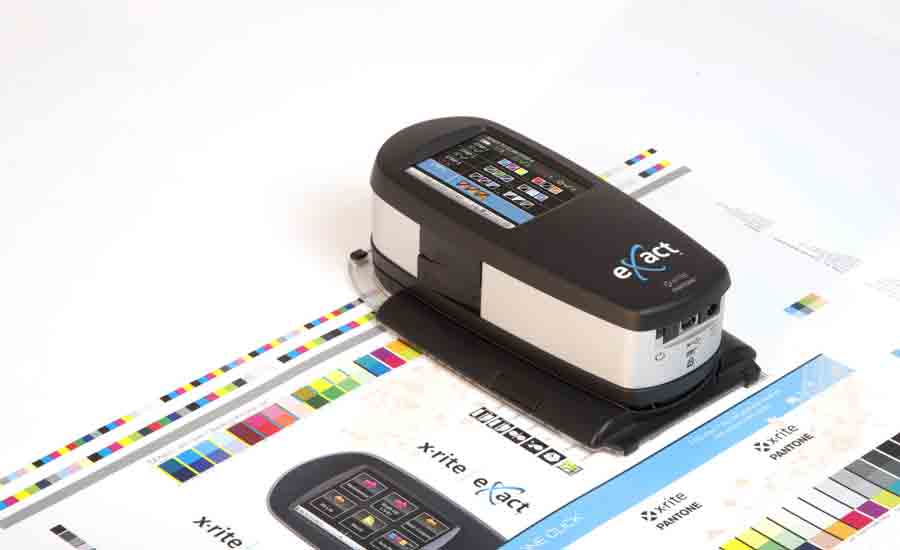
Using Spectros for Print

Packaging and Manufacturing by pcimag.com
Working Principle: Beer-Lambert’s Law
Beer-Lambert’s Law serves as a fundamental principle in spectrophotometry, establishing a quantitative relationship between the concentration of an analyte in a solution and the light it absorbs.
The law is mathematically represented by the equation ( A = epsilon b c ), where absorbance ( A ) depends directly on concentration ( c ), molar absorptivity ( epsilon ), and path length ( b ). This linear relationship allows for precise calculations of concentration based on measured absorbance. Absorbance typically ranges from 0 to 1, with absorbance of 0 indicating no light absorption. Nevertheless, it is essential to maintain ideal conditions to guarantee accuracy, as deviations can arise from high concentrations or interferences from other substances. The Dual beam design of instruments like the DS5 enhances accuracy and reliability in measurements, ensuring more dependable results in quantitative analysis. Understanding how molarity affects absorbance is crucial for achieving accurate results in spectrophotometric measurements.

Five Spectrophotometer Tips for Press Side by xrite.com
Key Components of a Spectrophotometer
Key components of a spectrophotometer include essential instruments that work in concert to measure light absorption and transmission accurately.
The light source, often a deuterium or halogen lamp, provides stable illumination. A spectrometer disperses light into its component wavelengths using prisms or gratings. The monochromator guarantees that only specific wavelengths reach the sample, maintaining spectral purity. This technique is widely used for quantitative analysis in fields like chemistry and biochemistry. The configuration of a spectrophotometer includes essential elements such as the light source, spectrometer, sample compartment, and detector, which collectively impact measurement accuracy. The instrument measures light intensity as a function of wavelength to provide detailed absorption spectra.
After passing through the sample, light intensity is measured by the detector, such as a photomultiplier tube. Finally, the display presents quantitative data, facilitating easy interpretation of results for effective color calibration and quality control in various applications.
Types of Spectrophotometers
Spectrophotometers are categorized into several types based on their operational principles and intended applications.
UV-Visible spectrophotometers operate within a wavelength range of 200-800 nm, quantifying compounds by measuring light absorption. They are commonly used in laboratories for colorimetric assays to determine concentrations of various substances. Single-beam spectrophotometers offer a large dynamic range and simple optics, making them a popular choice for many routine analyses. The technique is widely used in fields like chemistry and biochemistry for quantitative analysis.
UV-Visible spectrophotometers measure light absorption from 200-800 nm to quantify various compounds effectively.
Infrared spectrophotometers extend to 3300 nm, identifying molecular bonds and functional groups.
Fluorescence spectrophotometers excel in detecting emitted light from excited samples, offering high specificity.
Atomic absorption spectrophotometers focus on metals, ensuring quality control with parts-per-million sensitivity.
Specialized designs, such as double-beam and microplate spectrophotometers, enhance precision and efficiency in achieving color accuracy and meeting high-quality print standards across various quality control processes.
Applications Across Various Fields
While the applications of spectrophotometers are diverse, they markedly enhance analytical capabilities across various fields.
In environmental monitoring, they detect pollutants in air and water, ensuring compliance with regulations. Additionally, high sensitivity allows for the detection of minute changes in light absorption, improving pollutant detection accuracy. This is possible because different compounds absorb light at specific wavelengths, allowing for precise identification of various pollutants. Also, these instruments measure interaction of light with matter, which is crucial for identifying the specific nature of pollutants.
In pharmaceuticals, spectrophotometers facilitate drug development by evaluating purity and concentration.
Industrial uses include quality control for paints and coatings, ensuring accurate color reproduction and consistency.
In forensic science, they analyze trace evidence and toxic substances.
Academic research employs spectrophotometry to study molecular interactions and reaction kinetics.

Printing News by printingnews.com
Popular Wiki Terms:
Advantages and Limitations of Spectrophotometry
Although spectrophotometry offers numerous advantages, it also presents certain limitations that must be acknowledged.
Handheld spectrophotometers provide high sensitivity and accuracy, essential for color calibration in print production. They enable non-destructive measurements, preserving sample integrity during post-press quality assurance. These devices can measure a wide variety of substances, allowing for broader applications beyond just color analysis. Also be aware that spectrophotometry is widely used for determining concentration of various materials in samples. Also, spectrophotometers are capable of producing precise data that exceeds human eye capability, enhancing the reliability of measurements.
Nevertheless, these devices require regular calibration, which can be time-consuming. Measurements may be affected by environmental factors, such as temperature and light interference. Highly turbid samples may yield inaccurate results due to light scattering.
Despite these challenges, the benefits of spectrophotometry in ensuring consistent color reproduction in print applications are substantial and impactful.
References & Data Sources:
https://study.com/learn/lesson/what-does-a-spectrophotometer-measure.html – Retrieved April 27, 2025
https://www.hunterlab.com/blog/what-is-spectrophotometer/ – Retrieved April 29, 2024
https://en.wikipedia.org/wiki/Spectrophotometry – Retrieved January 29, 2025
https://techkonusa.com/should-i-use-a-densitometer-or-spectrophotometer-in-my-pressroom/ – Retrieved April 22, 2025
https://www.pcimag.com/articles/100957-using-spectros-for-print-packaging-and-manufacturing – Retrieved April 29, 2025
https://chem.libretexts.org/Bookshelves/Physical_and_Theoretical_Chemistry_Textbook_Maps/Supplemental_Modules_%28Physical_and_Theoretical_Chemistry%29/Spectroscopy/Electronic_Spectroscopy/Electronic_Spectroscopy_Basics/The_Beer-Lambert_Law – Retrieved April 29, 2025
https://www.edinst.com/resource/the-beer-lambert-law/ – Retrieved April 29, 2025
https://www.khanacademy.org/science/ap-chemistry-beta/x2eef969c74e0d802:intermolecular-forces-and-properties/x2eef969c74e0d802:beer-lambert-law/v/spectrophotometry-introduction – Retrieved April 29, 2025
https://www.xrite.com/blog/spectrophotometer-press-side – Retrieved April 29, 2025
https://chem.libretexts.org/Bookshelves/Physical_and_Theoretical_Chemistry_Textbook_Maps/Supplemental_Modules_%28Physical_and_Theoretical_Chemistry%29/Kinetics/02:_Reaction_Rates/2.01:_Experimental_Determination_of_Kinetics/2.1.05:_Spectrophotometry – Retrieved April 28, 2025
https://www.ssi.shimadzu.com/service-support/technical-support/analysis-basics/fundamentals-uv/structure.html – Retrieved April 28, 2025
https://microbenotes.com/spectrophotometer-principle-instrumentation-applications/ – Retrieved April 28, 2025
https://www.msesupplies.com/blogs/news/what-are-the-different-types-of-spectrophotometers – Retrieved April 28, 2025
https://www.biocompare.com/24549-Guide-to-Spectrophotometers/ – Retrieved April 28, 2025
https://lifesciences.danaher.com/us/en/library/spectrophotometry.html – Retrieved April 28, 2025
https://felixinstruments.com/blog/spectrophotometry-in-2023/ – Retrieved April 28, 2025
https://www.rdworldonline.com/spectrophotometer-applications-in-research-and-development/ – Retrieved April 28, 2025
https://www.printingnews.com/software-workflow/color-management/article/12121262/5-reasons-you-should-use-a-spectrophotometer – Retrieved April 28, 2025
https://www.drawellanalytical.com/what-does-a-spectrophotometer-measure-and-why-choose-it/ – Retrieved April 28, 2025
https://www.hunterlab.com/blog/spectrophotometer-vs-colorimeter-whats-the-difference/ – Retrieved April 28, 2025
https://www.munroscientific.co.uk/spectrophotometer-advantages-application-and-mechanism – Retrieved April 28, 2025