
Color Gamut Definition
Color gamut refers to the range of colors a device can reproduce or capture, indicating its limitations in accurately representing hues and saturation. It is typically mapped in the hue-saturation plane, where out-of-gamut colors cannot be reproduced faithfully. Effective color management, including ICC profiles and accurate conversions between RGB and CMYK, is essential to guarantee color fidelity. Understanding these concepts leads to improved practices in various industries, influencing outcomes in graphic design, printing, and broadcasting.

Quick Summary
- Color gamut refers to the range of colors a device can capture, reproduce, or display.
- Out-of-gamut colors cannot be accurately represented, necessitating effective color management.
- Different devices have varying gamuts, impacting color consistency across print and digital formats.
- Gamut mapping algorithms help manage out-of-gamut colors for accurate color reproduction.
- Understanding color gamut is crucial for graphic designers and industries reliant on precise color fidelity.
Understanding Color Gamut
Color gamut is a critical concept in color science, representing the range of colors that a device can capture or render. It is essential for achieving color accuracy in various applications. Color gamut is specified in the hue-saturation plane, highlighting the importance of understanding its limitations and implications. Understanding the color gamut standards allows users to choose the most suitable gamut for their specific needs.
Devices have inherent limitations that lead to out-of-gamut colors, which cannot be accurately reproduced. These colors necessitate careful management during workflows, particularly in RGB to CMYK conversions. Unintentional plagiarism can occur when colors from different devices are mixed without proper attribution, leading to inaccuracies. Conversion challenges arise when attempting to maintain color fidelity, as no perfect translation exists. Understanding these dynamics enables effective color management, ensuring that the output meets industry standards and satisfies the needs of users across different platforms and devices.
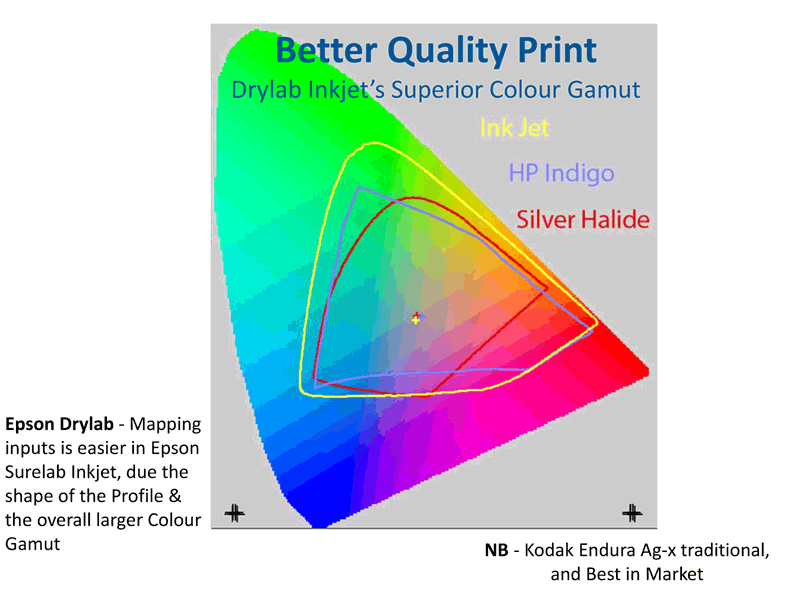
We compare the colour gamuts of the three photo printing ... by insideimaging.com.au
Visualization Techniques
Effective visualization techniques are integral to understanding color gamut and its implications in various applications. 3D histograms and color clouds represent individual pixels as colored dots, enhancing the visualization of gamut distribution. Gamut ring intersection techniques convert 3D color data into 2D visualizations, allowing for hue and chroma comparisons. Nevertheless, chromaticity diagrams have limitations, as they often ignore luminance, leading to incomplete representations of color spaces. Notably, the gamut ring intersection technique allows for a clearer understanding of the overlap between different color gamuts. Also, Gamut Rings provide an innovative approach to visualizing color reproduction capabilities, offering a more accurate representation of color gamuts. G7 Certification ensures that printers can maintain color consistency across different devices, which is essential for accurate color reproduction. Understanding CMYK color model is crucial for achieving precise control over color reproduction in print media. Gamut mapping algorithms, such as clipping and ray tracing chroma reduction, further assist in managing out-of-gamut colors for accurate color reproduction across devices, ensuring consistency and fidelity in visual outputs. Understanding gamut mapping is essential for ensuring accurate color representation across different devices and mediums.
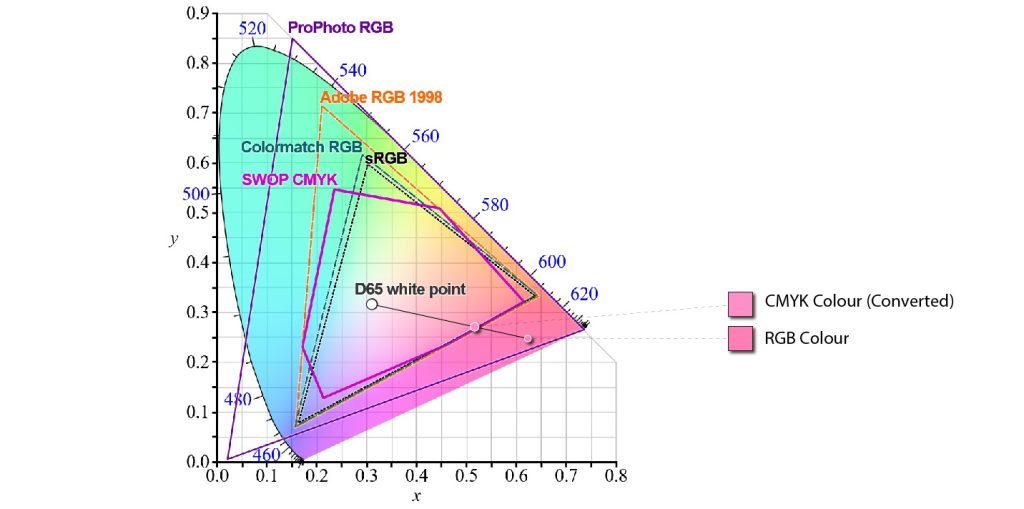
Why CMYK prints look different compared to RGB images on screen ... by edinburghcopyshop.co.uk
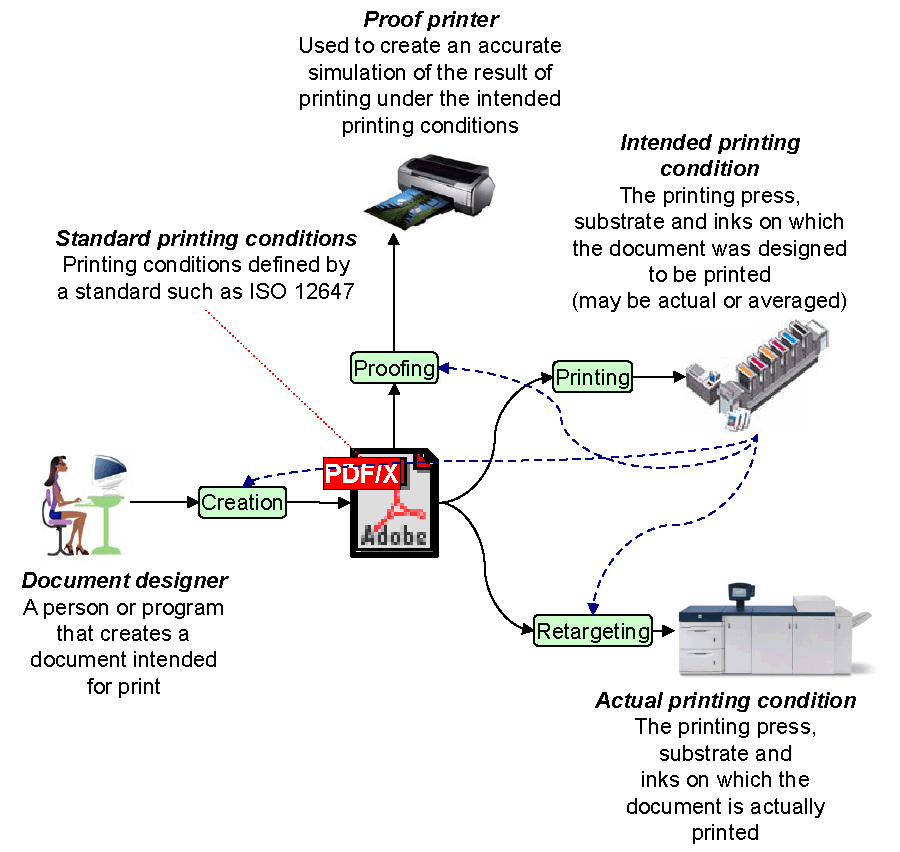
Exchange space for 'pure digital' printing by color.org
Key Standards and Their Applications
Standards pertaining to color gamut play an important role in guaranteeing consistent and accurate color representation across various digital and print media. Among these, PDF/X serves as a key format for print-ready files, while Adobe Photoshop is widely used for image editing. Adherence to CMYK color space is critical for print applications, as it guarantees accurate color reproduction. Ink density is also a significant factor that influences the vibrancy and richness of colors in printed materials. Additionally, ICC profiles are crucial tools that help maintain color fidelity throughout the workflow. Professionals must also be aware of potential color shifts in conversion when moving between color spaces. Utilizing ICC profiles can mitigate these issues, enhancing color fidelity throughout the workflow. Understanding these standards is crucial for achieving the best results in visual communications, especially since color gamut defines a specific range of colors identifiable by the human eye. Knowing that different monitors have varying color gamuts can significantly impact how images are perceived across devices.
Practical Uses in Various Industries
In various industries, the practical applications of color gamut are essential for ensuring accurate color reproduction and consistency across different media. Graphic designers utilize color mapping functions and ICC profiles to maintain fidelity between digital and print outputs. In inkjet printing, ink formulations play a crucial role in achieving the desired color gamut, as they determine the range and vibrancy of colors produced. The use of CMYK Color Mode is vital in achieving consistent colors in printed materials. In photography, adherence to total ink coverage (TAC) standards minimizes color shifts during the printing process. A wider color gamut allows for more vibrant and accurate colors, which is crucial in achieving true-to-life visuals. Film and broadcasting rely on precise color management to align DCI-P3 standards with display technology. Soft proofing tools like GMG ColorProof or EFI Fiery XF facilitate accurate previews, ensuring that final products meet client expectations while effectively managing color across diverse platforms.
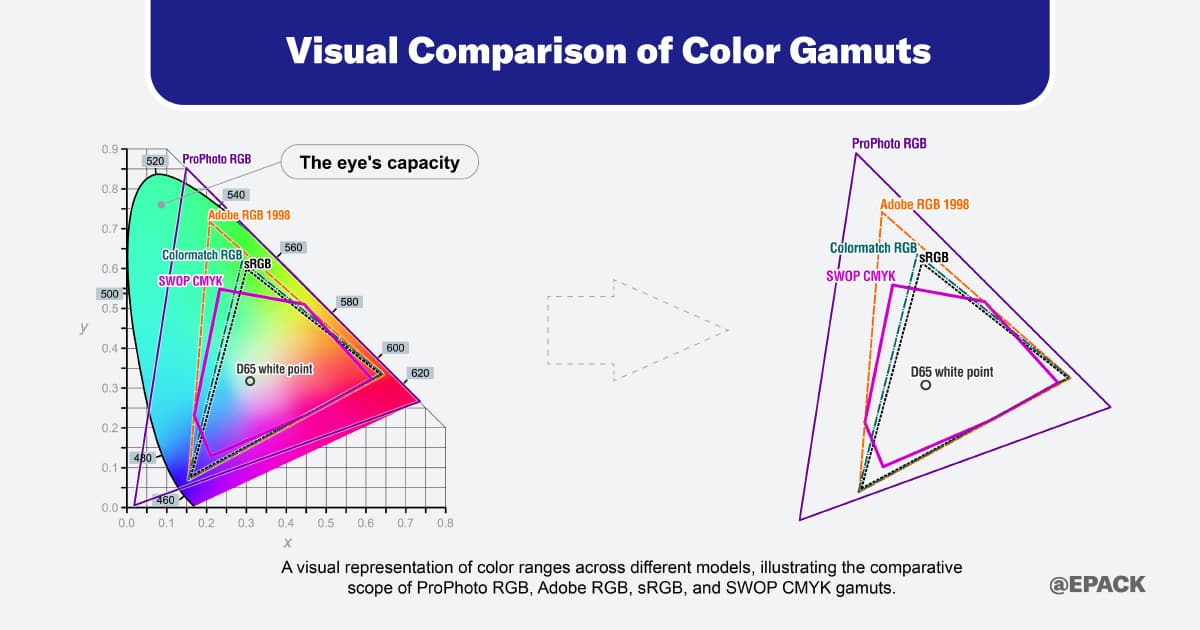
CMYK Printing Guide: Achieve Vibrant and Accurate Colors by epackprinting.com
Popular Wiki Terms:
Challenges in Color Reproduction
Challenges in color reproduction arise from multiple factors that hinder the accurate translation of colors across different devices and media.
Device link profiles are essential for managing color consistency, yet variations in ink formulations can lead to gamut mismatches. Total ink coverage (TAC) must be monitored to prevent ink limit exceedance, which adversely affects print quality. Proofing processes are critical for identifying potential color shifts, but environmental factors like humidity and temperature can further complicate outcomes. Ultimately, these challenges necessitate an extensive understanding of color gamut and media variations to achieve ideal results in color reproduction. Regular color calibration is crucial for maintaining the quality and effectiveness of printed materials, as inconsistencies can lead to brand identity loss and miscommunication. Maintaining optimal printing environment temperature is essential for minimizing the impact of environmental variations on color reproduction. Adopting ISO Print Standards can significantly improve the consistency and quality of color reproduction across various media.
References & Data Sources:
https://en.wikipedia.org/wiki/Gamut – Retrieved April 6, 2025
https://www.benq.com/en-us/knowledge-center/knowledge/color-gamut-monitor.html – Retrieved April 8, 2024
https://quizlet.com/770233286/bcom-m4-flash-cards/ – Retrieved January 8, 2025
https://insideimaging.com.au/2019/running-the-colour-gamut/ – Retrieved April 1, 2025
https://displaydaily.com/how-gamut-ring-visualization-transforms-display-color-analysis/ – Retrieved April 8, 2025
https://www.tvtechnology.com/news/nhk-explains-how-gamut-rings-offer-better-way-to-visualize-color-gamut – Retrieved April 8, 2025
https://224664-286886.apps-06.cloudsonic.dev/term/g7-certification/ – Retrieved April 8, 2025
https://224664-286886.apps-06.cloudsonic.dev/term/cmyk-cyan-magenta-yellow-black/ – Retrieved April 8, 2025
https://facelessuser.github.io/coloraide/gamut/ – Retrieved April 8, 2025
https://www.edinburghcopyshop.co.uk/help-topics/why-cmyk-prints-differ-to-rgb-images-on-screen/ – Retrieved April 7, 2025
https://www.color.org/exchange_space.xalter – Retrieved April 7, 2025
https://224664-286886.apps-06.cloudsonic.dev/term/ink-density/ – Retrieved April 7, 2025
https://224664-286886.apps-06.cloudsonic.dev/term/icc-international-color-consortium/ – Retrieved April 7, 2025
https://www.eizo.com/library/basics/lcd_monitor_color_gamut/ – Retrieved April 7, 2025
https://uperfect.com/blogs/portable-monitor/differences-between-color-gamut-srgb-ntsc-adobe-rgb-dci-p3 – Retrieved April 7, 2025
https://224664-286886.apps-06.cloudsonic.dev/term/inkjet/ – Retrieved April 7, 2025
https://224664-286886.apps-06.cloudsonic.dev/term/cmyk-color-mode/ – Retrieved April 7, 2025
https://www.seenebula.com/blogs/buying-guides/what-is-color-gamut – Retrieved April 7, 2025
https://www.epackprinting.com/support/understanding-cmyk/ – Retrieved April 7, 2025
https://library.fiveable.me/color-theory-and-application/unit-4/color-gamut-limitations/study-guide/idCSs1VUKllmbSxu – Retrieved April 7, 2025
https://224664-286886.apps-06.cloudsonic.dev/term/color-calibration/ – Retrieved April 7, 2025
https://colorbase.com/blog-mistakes-that-can-affect-color-reproduction/ – Retrieved April 7, 2025
https://224664-286886.apps-06.cloudsonic.dev/term/iso-print-standards/ – Retrieved April 7, 2025